Preserving Family Legacy Through AI and 3D Printing
For Graxinha, 3D printing is more than a creative hobby — it’s a way to preserve family history.
As the third-generation successor of her family workshop, she grew up surrounded by tools, machinery, repair benches, and stories passed down across generations. Even after her grandfather — the original founder of the workshop — passed away 22 years ago, his presence never truly disappeared.
She still remembered:
- His reading glasses resting low on his nose
- The sound of tools echoing through the workshop
- The way he leaned over the workbench repairing motors
- His hands carefully adjusting tiny machine parts late into the night
When the family recently renovated and expanded the workshop, she had one thought:
“If my grandfather could see the workshop today, what would he say?”
That question inspired a deeply personal project:
She wanted to create a physical memorial for her father — something more meaningful than a framed photograph.
Not just an image.
A presence.
A memory you could actually touch.
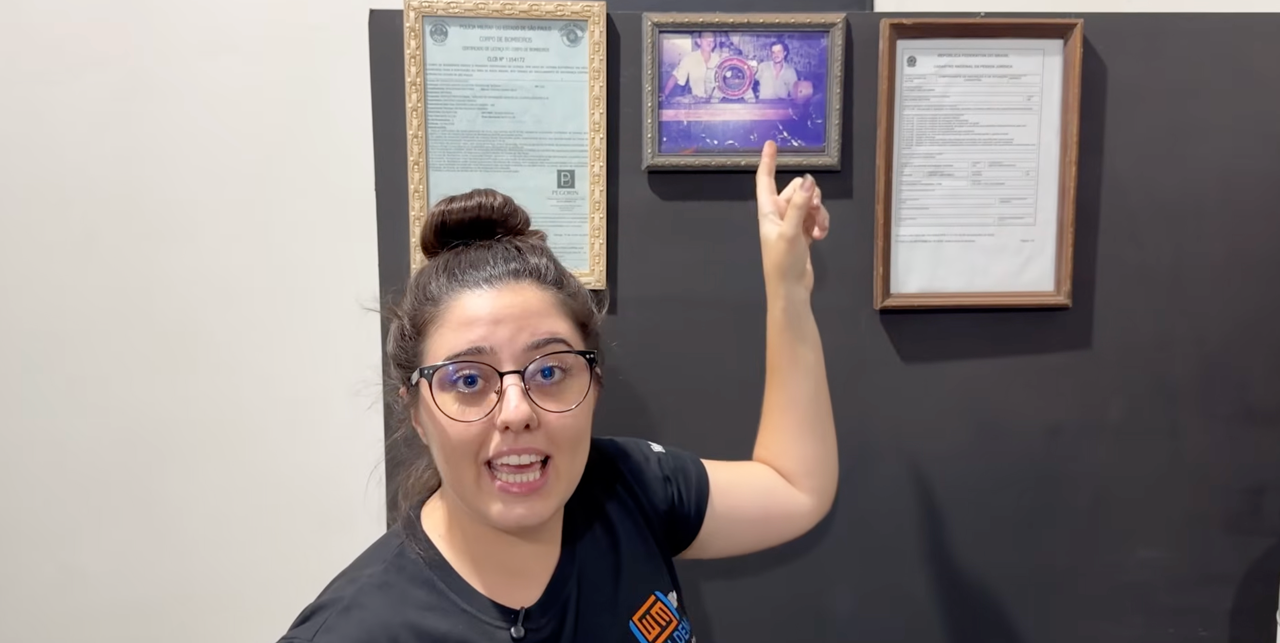
The Challenge: Turning an Old Photo Into a 3D Printable Portrait
The idea sounded beautiful.
But technically, it felt impossible.
Graxinha had no professional 3D modeling experience. She tried several AI modeling tools hoping to convert an old family photograph into a printable 3D portrait.
The results were disappointing:
- Distorted facial features
- Broken geometry
- Hollow meshes
- Poor likeness accuracy
- Unprintable model structures
Some tools generated models that barely resembled her grandfather. Others created corrupted meshes that couldn’t even pass slicing checks for 3D printing.
Without sculpting knowledge or advanced modeling skills, she began to believe the project might never become real.
Discovering Hi3D: Bringing a Family Memory Back to Life
Everything changed when she discovered Hi3D — an AI image-to-3D platform designed for creators, makers, students, and 3D printing enthusiasts.
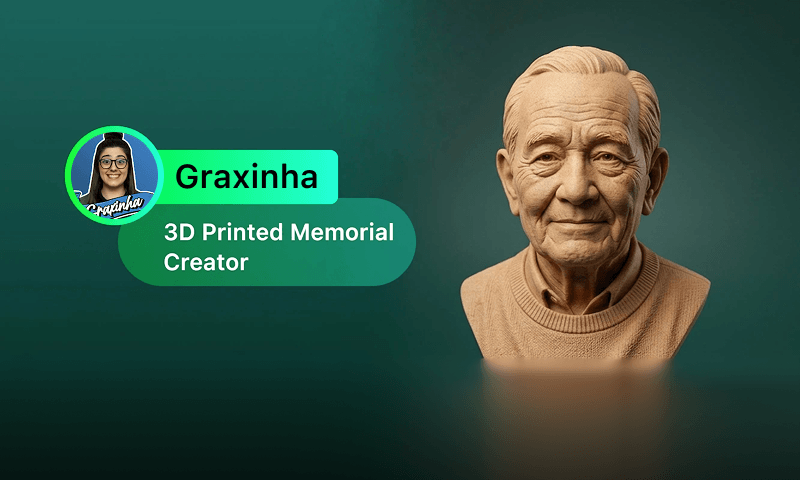
Using a single old photograph, she was finally able to recreate her grandfather as a detailed 3D printable portrait.
And for the first time, the memory felt real again.
1. Highly Accurate AI Portrait Reconstruction
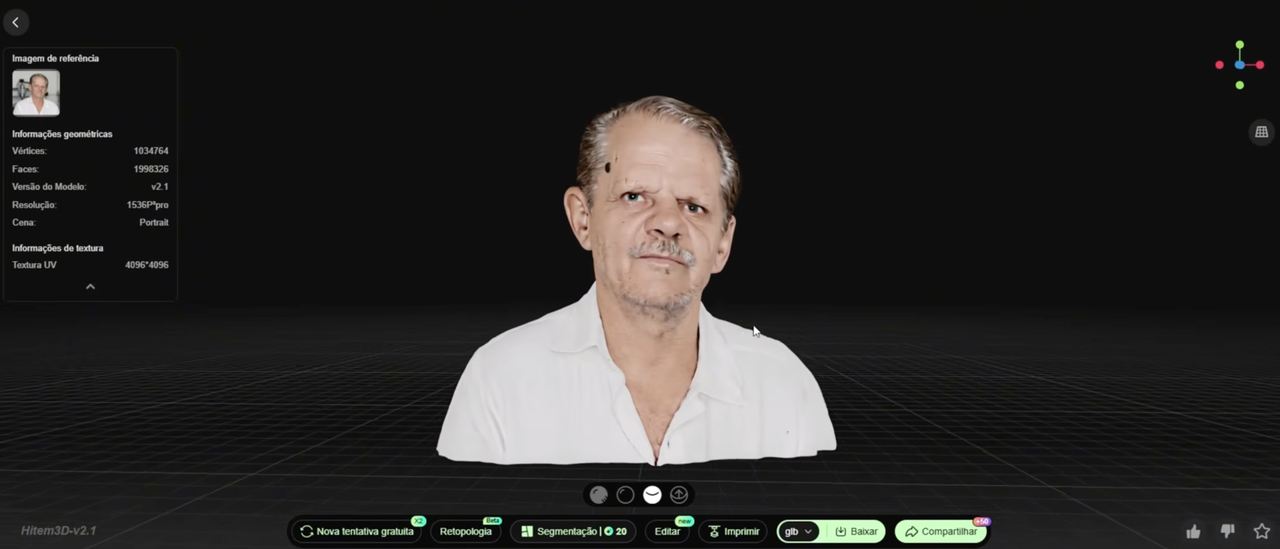
She uploaded an old portrait photo and selected Hi3D’s portrait-generation mode.
What surprised her most wasn’t just the technical quality.
It was the emotional accuracy.
Hi3D successfully recreated:
- Her grandfather’s white hair
- His facial expression
- His posture and presence
- The subtle details that made him recognizable
Unlike many AI tools, the generated model avoided common problems like:
- Facial distortion
- Broken geometry
- Melting features
- Surface artifacts
- Low-detail facial structures
When she saw the generated model for the first time, she immediately burst into tears.
It felt as if her grandfather had stepped out of the photograph.
2. Beginner-Friendly Workflow — No 3D Modeling Experience Needed
One of the biggest reasons the project succeeded was how simple the workflow felt.
The process was straightforward:
- Upload an old photograph
- Generate a 3D portrait model
- Export the file for printing
That was it.
No sculpting experience.
No complicated software pipeline.
No manual topology rebuilding.
The generated model already had:
- Complete geometry
- Stable wall thickness
- Printable mesh structure
- Clean surfaces
- No non-manifold mesh issues
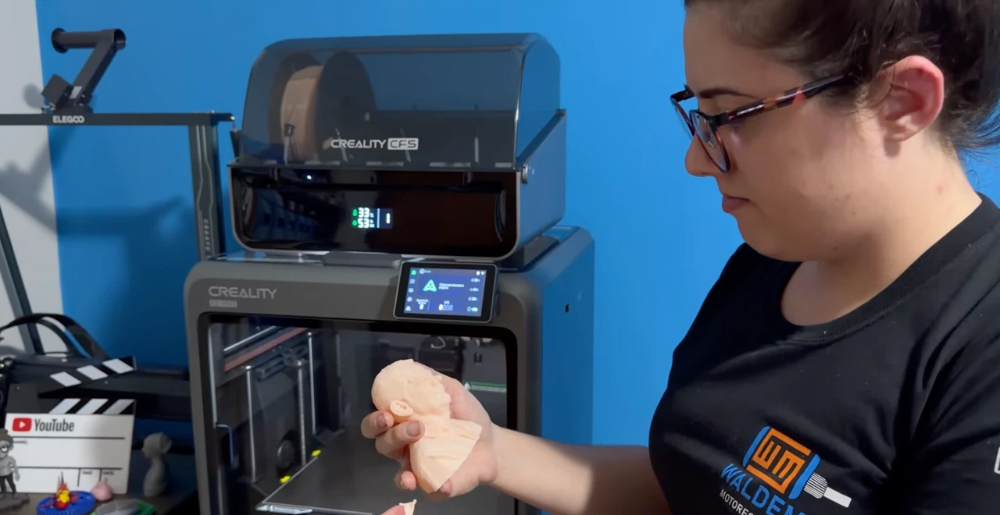
She could import the model directly into slicing software and prepare it for resin printing almost immediately.
For makers and hobbyists without professional modeling backgrounds, this dramatically lowers the barrier to creating personalized 3D printed memorials.
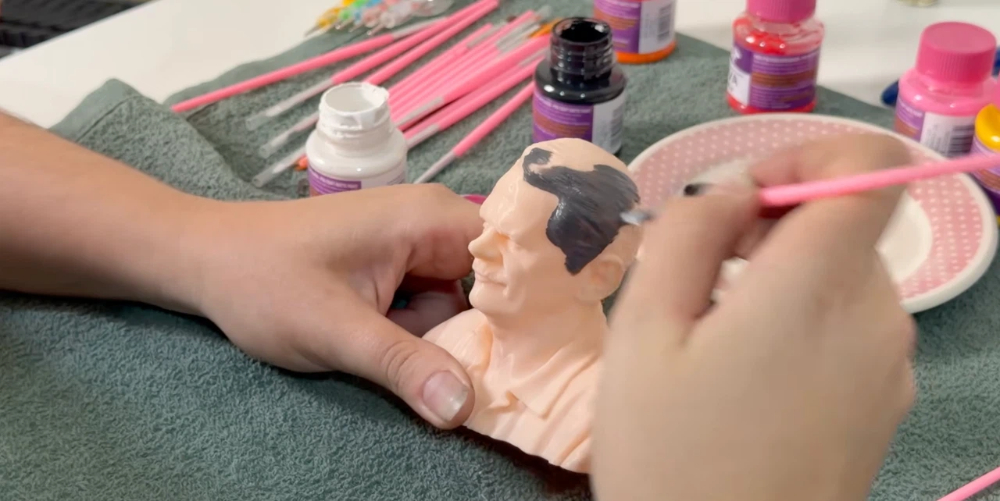
3. Hand-Painting the Final Model Added Emotional Meaning
After printing the raw model, she decided to finish everything by hand.
She bought a painting kit and carefully recreated every detail:
- Her grandfather’s white shirt
- His silver hair
- The subtle tones of his face
- The atmosphere of the family workshop
She also designed a custom workshop-style display base engraved with:
“WALDEMAR 50 Anos”
During the painting process, she described the experience as feeling like a conversation with her grandfather.
Every brushstroke carried memory, emotion, and gratitude.
The Delivery Moment: A Gift That Moved Her Father to Tears
When the final memorial piece was complete, she presented it to her father inside the workshop.
He stared at the model silently for a long time.
Then he hugged her tightly.
For a moment, it felt as though the founder of the workshop had returned to stand beside them again.
Today, the memorial sits prominently inside the family workshop.
Every time they walk in, they see him there.
Not as a fading photograph.
But as a tangible part of the space he built decades ago.
As Graxinha later shared in her video:
“This isn’t just a model. It’s our family story. It’s a memory you can touch.”
More Than a 3D Model: Using Technology to Preserve Human Connection
For Graxinha, the experience completely changed the way she viewed AI and 3D printing.
“I used to think the people in old photographs could only live in memories. But Hi3D showed me that with just one photo, you can transform emotion into something physical — something you can actually see and hold.”
She emphasized that she was never a professional 3D artist.
She didn’t know advanced modeling software.
But Hi3D helped her turn emotion into reality without technical barriers.
And when she saw her father holding the finished portrait with tears in his eyes, she realized the project had become something much larger:
It connected three generations of her family through creativity, memory, and technology.
Why Makers and 3D Printing Enthusiasts Are Exploring AI Memorial Modeling
Projects like this are becoming increasingly meaningful within the maker and 3D printing community.
Creators are now using AI-generated 3D models for:
- Personalized memorial sculptures
- Family keepsakes
- Custom figurines
- Heritage preservation
- AI-generated busts
- Resin printed portraits
- Personalized gifts
- Memory preservation projects
The combination of AI image-to-3D generation and consumer 3D printing is opening entirely new creative possibilities for hobbyists and makers around the world.
What Is Hi3D?
Hi3D AI Image-to-3D Platform is an AI-powered image-to-3D generation platform built for:
- Designers
- Students
- Makers
- Hobbyists
- 3D printing creators
- Digital artists
Hi3D focuses on three major strengths:
- Highly accurate portrait reconstruction
- High-fidelity textures and details
- Directly printable 3D model generation
The platform helps creators move from concept to physical objects faster — without requiring advanced 3D modeling experience.
Whether you’re creating:
- custom 3D printed gifts
- AI-generated figurines
- personalized memorial models
- resin printed portraits
- family keepsakes
- collectible statues
- workshop display pieces
Hi3D makes it easier to turn meaningful ideas into real-world creations.
Turn Your Memories Into Tangible Creations
If you’re a maker, hobbyist, or 3D printing enthusiast looking to create personalized models from photographs, explore what’s possible with:
- AI portrait to 3D model generation
- Printable family memorial sculptures
- Custom resin printing workflows
- AI-generated collectible figures
- Personalized 3D printed gifts
Start creating with Hi3D Official Website today — and transform memories into something you can truly hold.
This issue’s featured creator: Graxinha
Identity tags: Third-Generation Heir of a Family Workshop, 3D Printed Memorial Creator
Creative philosophy: Using technology to preserve family stories, turning invisible longing into tangible warmth.
Social Media:https://www.youtube.com/@graaxinha